
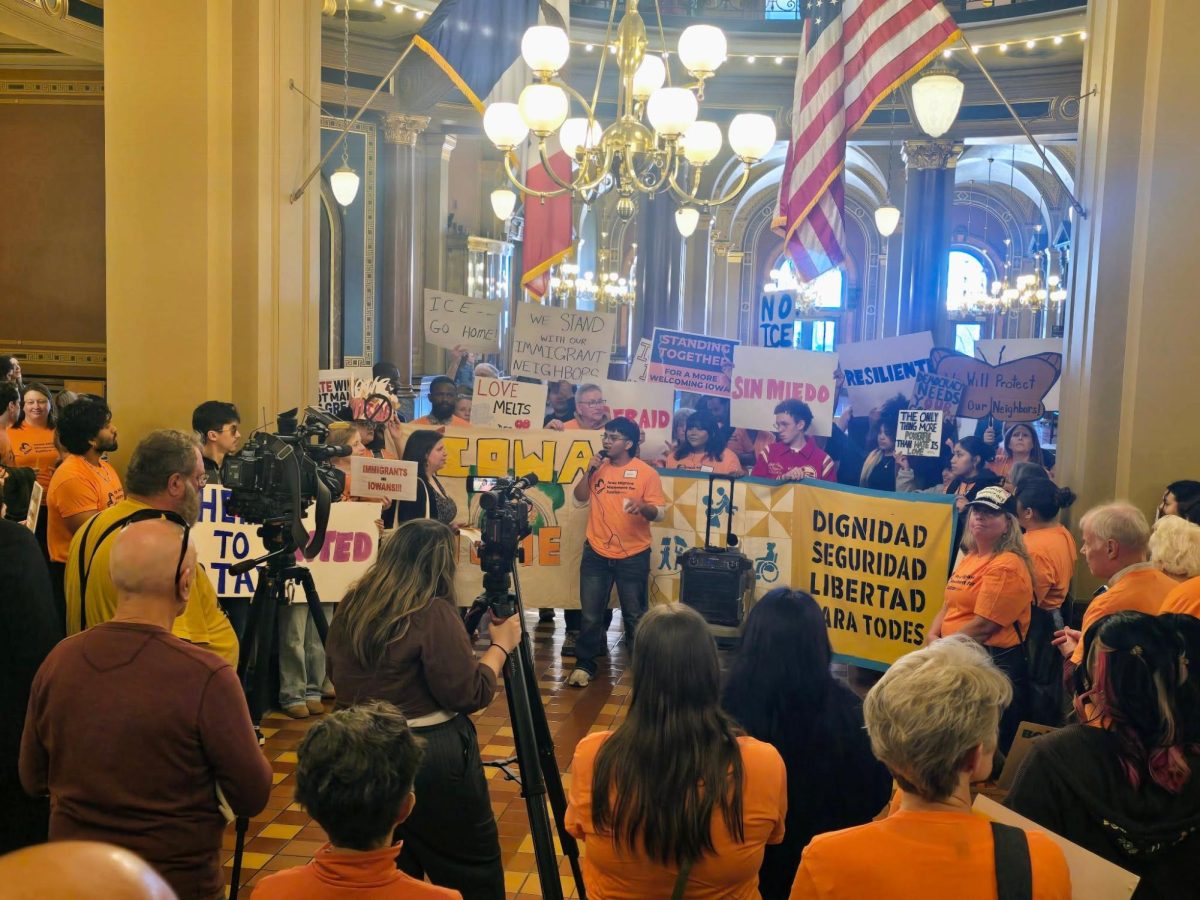
On Wednesday, Feb. 18, the halls of the Iowa State Capitol filled with chants, conversations and determined individuals as the Iowa Migrant Movement for Justice hosted its Advocacy Day in Des Moines.
The statewide advocacy organization — led by immigrant and refugee voices united with allies — brought together community members from across Iowa to speak directly with lawmakers about legislation impacting immigrant families and other marginalized communities.
Among those who attended were students from the University of Northern Iowa, representing UNIdos, a student organization focused on uplifting Latino and immigrant voices on campus.
For Lusia Alvarez Mendoza, a senior elementary education major with a minor in Spanish and program coordinator of UNIdos, Advocacy Day was about more than a trip to the Capitol.
“Advocacy Day was a powerful opportunity for community members to come together and speak directly with legislators about issues impacting our communities,” Alvarez Mendoza said. The day focused on anti-immigration legislation, as well as bills affecting women, people of color and low-income families.
Participants attended educational sessions on how to effectively communicate with lawmakers, propose legislation and navigate the legislative process before meeting with representatives. For Alvarez Mendoza, the experience highlighted that advocacy is often about starting conversations rather than seeing immediate results.
“Sometimes it is about planting a seed,” she said. “Starting a conversation that can grow into meaningful reform.”
Alvarez Mendoza learned about the event through her older sister, Maria Gonzalez Alvarez, who works for the Iowa Migrant Movement for Justice and previously co-founded Immigrant Allies in Marshalltown, an organization that provides free information and resources to migrant families. Inspired by her sister’s commitment to community service, Alvarez Mendoza helped coordinate UNI student participation.
She worked alongside UNIdos Director of Administration Osmar Castro to design and distribute flyers and organize an RSVP form. As program coordinator, she said she felt responsible for not only informing students, but for encouraging them to step into civic spaces.
For both Alvarez Mendoza and Dulce Bucio, a second-year graphic design major and UNIdos director of public relations, the event was deeply personal.
Alvarez Mendoza, a first-generation Mexican American and daughter of immigrants, shared that her mother was detained by ICE when she was three years old. Her older sister, then 18, became the primary caregiver for four younger siblings.
“Experiences like mine are not isolated,” she said. “They are the reality for many families across our nation.”
Bucio echoed similar sentiments.
“As a product of immigrants, I know that I am not a threat and neither are the others in our community,” she said.
Advocacy Day provided students the opportunity to meet directly with the state representatives after receiving guidance on how to present their concerns. Bucio prepared to speak with a representative regarding three anti-immigrant bills. Although he was not present in his office that day, she said her goal was to urge opposition to the legislation and emphasize the contributions immigrants make to the country.
“My motive was to hopefully convince him not to pass the bill and to show him the importance of immigrants in this country,” Bucio said. “Because I know that if our brothers and sisters lose rights, so do I. That’s how it starts — one compromise at a time.”
Throughout the day, students rallied inside the Capitol, joining advocates from across the state. Organizers emphasized that civic engagement extends beyond voting in presidential elections and includes participation in local and state decision-making.
Alvarez Mendoza stressed that the policies debated in statehouses directly affect classrooms, healthcare access, housing and civil rights.
“As college students, we both have the privilege of education and the responsibility to use our knowledge to advocate for positive change,” she said.
Bucio agreed, adding that student involvement helps counter stereotypes about political apathy among younger generations.
“It was incredible to see so many college students using their voices and proving to the older generations that we are not apathetic and are educated,” she said.
Both students described Advocacy Day as an opportunity to not just show support, but to take meaningful action and set an example for peers and future generations.
“Advocacy Day was more than an event; it was a reminder that our voices matter,” Alvarez Mendoza said. “Change doesn’t happen overnight, but it begins with courageous conversations and collective action.”


